

Agentic AI opens up new possibilities for working with complex scientific and environmental data. Through our experiments, we've learned that giving agents more freedom doesn't necessarily produce better results.

Agentic AI opens up new possibilities for working with complex scientific and environmental data. We've spent plenty of time experimenting with agents, trying different approaches, and burning through more tokens than we'd like to admit. All for what?
One thing we've learned is that giving agents more freedom doesn't necessarily produce better results.
In many cases, the more useful approach is to introduce constraints: limit the tools an agent can use, define how it returns information, or choose a smaller model for a specific task. These constraints can make agents more predictable and efficient. They don't solve every problem with agentic AI, but they've become a useful part of how we're experimenting.
Much of our work at Development Seed has focused on making Earth data easier to find, access, and process through open standards, cloud-native formats, and interoperable tools. That foundation is just as important for machines as it is for people. Agents can build on these existing services to discover data and carry out scientific workflows, without needing to reinvent how the underlying data is accessed or processed.
Here are three ways we've explored this through our work.
Working within these constraints is where some of the most interesting innovation is happening.
Limit what agents can do
One way to constrain agents is to give them a specific set of tools rather than letting them generate or execute anything. Granted, these tools can be quite broad, such as generating Python code. But we've found that smaller, more focused tools are usually easier to control and maintain. It's a familiar software engineering principle: keep things small and composable.
We've used this approach in several projects:
- GeoAssistant: A LangGraph-based agent that can query the Overture Places API and retrieve NAIP imagery.
- Global Nature Watch Horizon: Agents that generate code as an intermediate step rather than producing unconstrained text or image outputs.
In these examples, the agent decides which tools to use, while the tools handle the actual work. Rather than relying on a language model to generate every result, we can use existing APIs and services to retrieve and process the data.
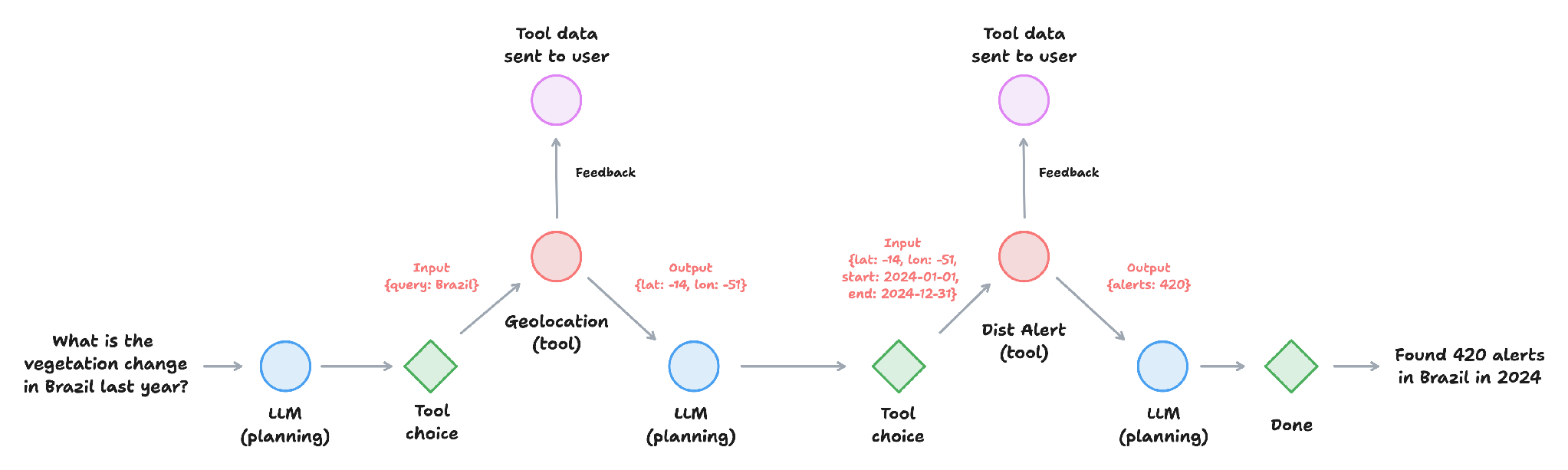
Agents/LLM orchestrate, tools produce facts. The top-level agent plays a coordinating role only, it will pick an appropriate tool based on a user’s query, look at intermediate outputs, and call out to the next tool. The tools produce facts in a deterministic manner, while the agents act as a user-interface and glue between tools.
Controlling how agents respond
When working with scientific and environmental data, we need to be careful about how language models present information. Even when an agent retrieves the right data, asking a model to generate a response introduces another opportunity for errors.
One approach is Retrieval-Augmented Generation (RAG), which grounds responses in an existing knowledge base. This can reduce mistakes, although it doesn't eliminate them. We can go a step further by limiting the format of an agent's response as well.
At the Responsible AI Hackweek, Lilly Thomas demonstrated a snow cover analysis agent that retrieves information from reliable APIs and fills in a predefined response template. Rather than spending tokens generating a long explanation, the agent returns information in a predictable format. The workflow costs only cents per query. We've explored similar approaches in our work on NASA Earth Information Explorer (EIE).
Another method we’ve tried is to keep the original data separate from the generated text. An agent can identify relevant data and use well-defined tools to retrieve or process it. The results are then delivered to the application for visualization, without passing through another round of text generation. Unlike many agents where the LLM’s output is the final answer, we are building agents that return the underlying data itself—rendered maps, statistics, and dataset links—so users can inspect primary sources alongside any natural language output.
Earth Information Explorer
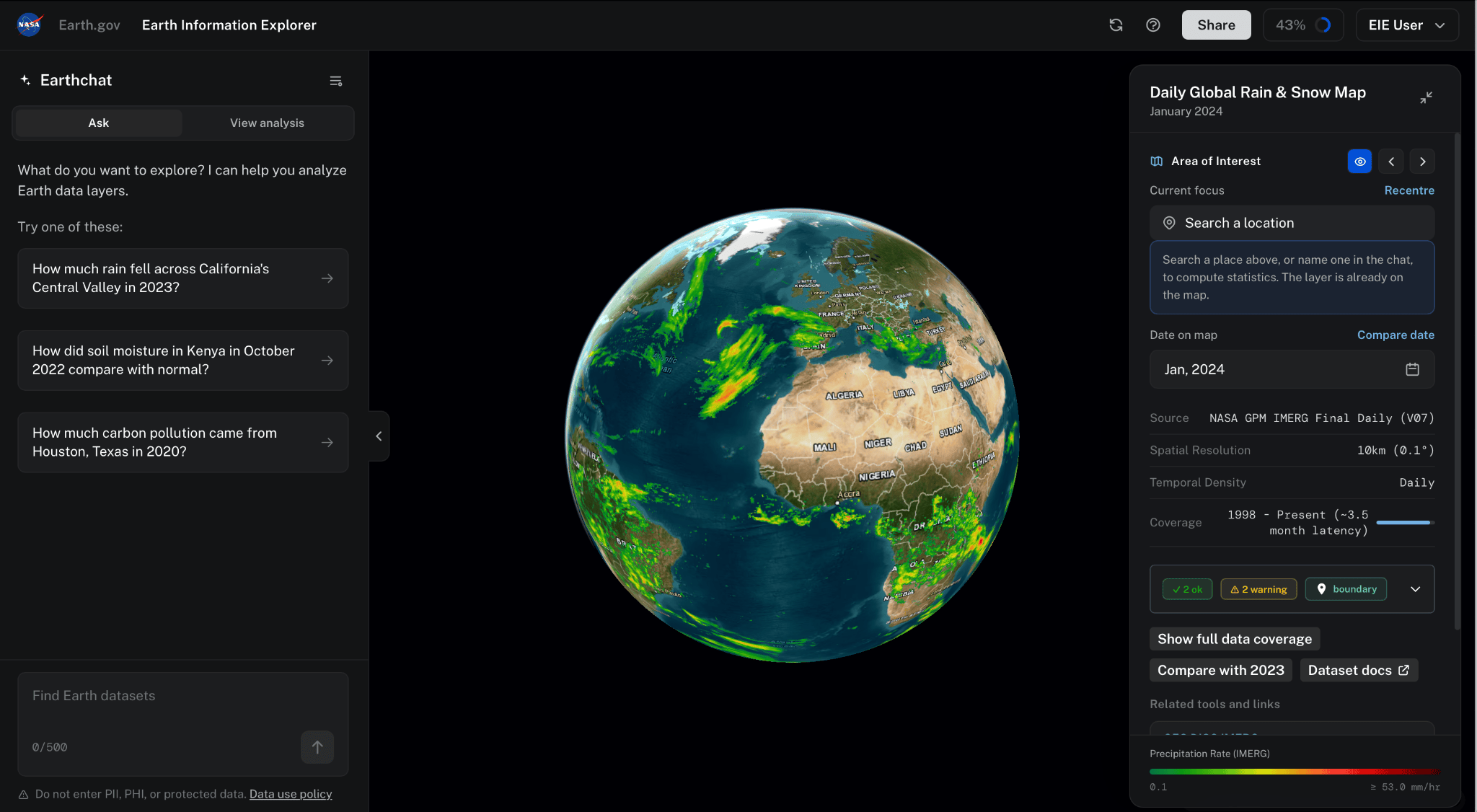
The Earth Information Explorer (EIE) interface. Note: designs subject to change in final version.
These agent development patterns are applicable to bounded, well-defined use cases where the types of questions and analyses users will request are known in advance. It works best when the workflow can be decomposed into a finite set of discrete tools, and when predictability, reproducibility and cost efficiency matter more than open-ended flexibility.
Choosing smaller, focused models
Regardless of the workflow, the brain of an agent is still a language model. It's easy to reach for the largest, most capable model available. But do we really need a frontier-level model for every task? Large, general-purpose models can be expensive to run, especially when an agent makes repeated calls to complete a task. For organizations that provide data and services for free, those costs can become difficult to manage.
For well-defined tasks, a smaller model may be sufficient. Some open-weight models can also be hosted on an organization's own infrastructure, providing more control over operating costs and where data is processed. We've experimented with Small Language Models (SLMs) for geocoding through Gazet. We're also looking at ways to optimize smaller models for particular tasks rather than using a large, general-purpose model for everything.
Smaller models won't work for every application, but they might be a good solution when the task is narrow enough. They can also offer options for organizations concerned about privacy or dependence on external model providers.
Try the Gazet demo on Hugging Face.
Building agents with constraints
There's plenty of excitement around increasingly autonomous AI systems. But through our own experiments, we've found that giving agents fewer options can sometimes produce more useful results.
Limiting the tools they can access, controlling their outputs, and using smaller models are all ways to make agentic workflows more predictable and manageable. There are tradeoffs, of course, and we're still learning where these approaches work best.
In a way, working within these constraints is where some of the most interesting innovation is happening. Rather than trying to build agents that can do everything, we're finding ways to make them useful for specific tasks, with the tools and resources we actually have.
For organizations working with scientific and environmental data, the opportunity isn't just to add AI to existing services. It's to make that data and the tools around it easier to use in new workflows. We're interested in helping organizations make that transition, building on the standards and infrastructure they already rely on rather than replacing them.
Our GeoAI team will be in Berlin the week of October 19th at the Agentic AI for Earth Observation conference, and we'd love to hear how others are approaching these challenges. Find us there, or get in touch to continue the conversation.
Related content
More for you
What we're doing.
Latest