
CASEI (“KAY-see”) is a centralized, comprehensive metadata resource for NASA-funded airborne and field Earth Science data. CASEI provides extensive, cross-disciplinary information and context, previously spread out across multiple sources or not readily accessible at all, for suborbital research endeavors and anyone curious about NASA’s non-satellite Earth observations.

Overview
The Catalog of Archived Suborbital Earth Science Investigations (CASEI) provides curated information about the context, motivation, funding mechanisms, science objective(s), and other details on NASA’s non-satellite, Earth-focused platforms, instruments, and data products. Development Seed partnered with NASA ODSI’s Airborne Data Management Group (ADMG) to create a comprehensive inventory of NASA-funded airborne and field investigation metadata.
Challenge
Before CASEI, NASA did not have a comprehensive inventory of holistic, contextual information on its airborne and field investigations. Information was available only via separate data repositories, outdated project websites (if still hosted), and buried in journal articles from an array of publishers.
Outcome
CASEI is the most extensive search and discovery platform available to Earth science researchers and anyone interested in learning more about NASA’s non-satellite, or suborbital, observations. CASEI is cross-disciplinary and comprehensive, covering a range of geophysical concepts. It stands out for having information that is hard to locate and providing context so scientists can make informed decisions and re/use data appropriately.
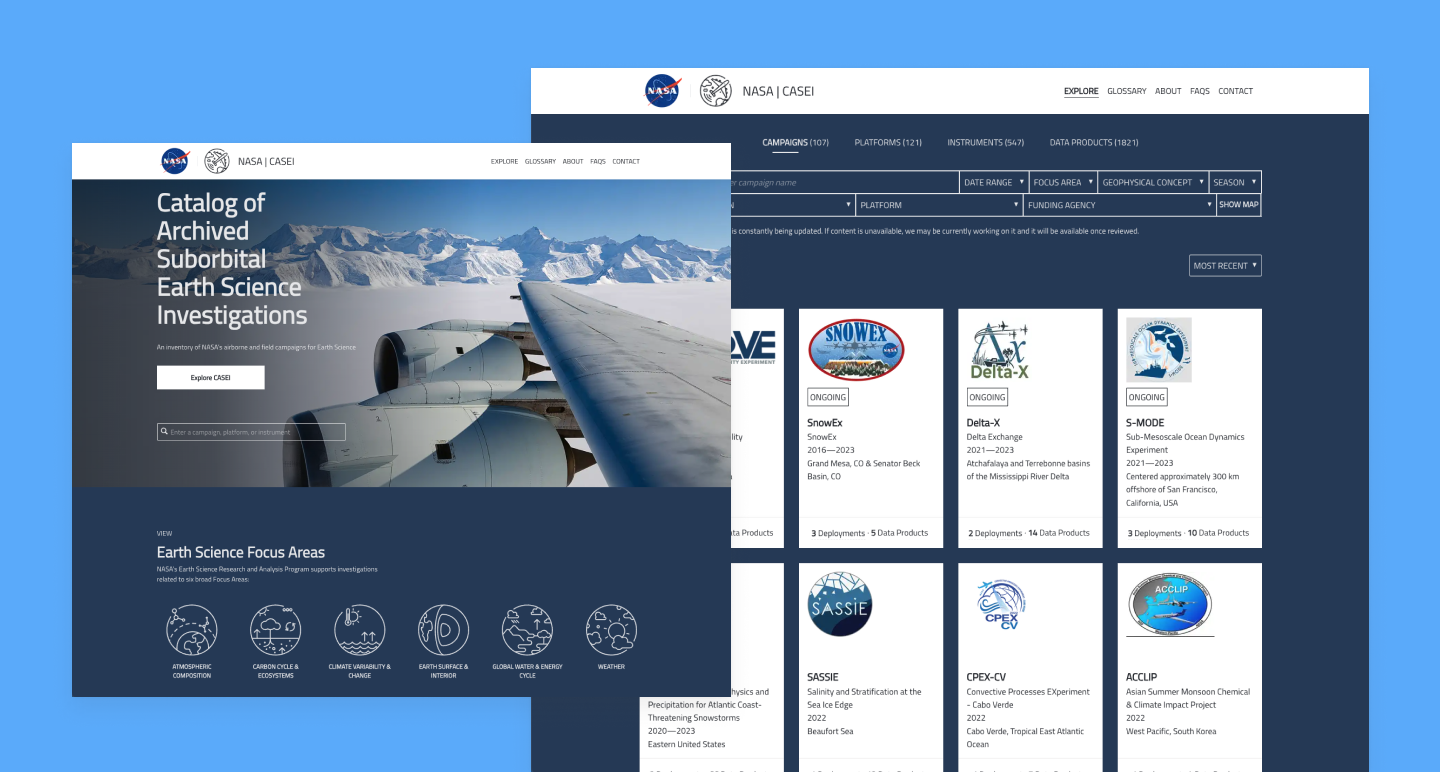
CASEI homepage and explore page showing NASA airborne and field investigations.
A search interface for highly curated metadata
Non-satellite observations are often less discoverable and findable than satellite-based data. Research was conducted with airborne scientists to learn about the unique challenges of working with airborne data, including being broadly distributed, highly linked, and non-standardized. Historical data can be hard to find, is often isolated, and/or inadequately documented. Even when looking for the same result, everything from terminology to tools can be nuanced across disciplines, making information on what observations exist (and how to access them) harder for airborne research communities to find.
This is why CASEI was designed to promote the exploration of content. The interface makes it easy to explore archived NASA field investigation data across NASA data centers that may be relevant to a scientist’s research but largely unknown. Scientists arriving at CASEI come from various scientific fields and may be interested in niche areas. Once you find the data you came looking for, CASEI also makes it easy to discover other related data through novel metadata concepts.
Detailed view of a field campaign showing how it links to other relevant metadata associated with that campaign.
A maintenance interface for data curators to add new metadata
In addition to building the search interface to intuitively explore CASEI, we developed the maintenance interface to support the ADMG data curators who need to add and update metadata to the catalog. Previously, metadata collection and curation was managed across massive spreadsheets, so this system helps keep content entered more secure. CASEI metadata curators also go to great lengths to vet and verify the information added to the catalog. By moving that information into a database and streamlining the content approval process into a system, curators can maintain focus on content accuracy while adding information more efficiently.
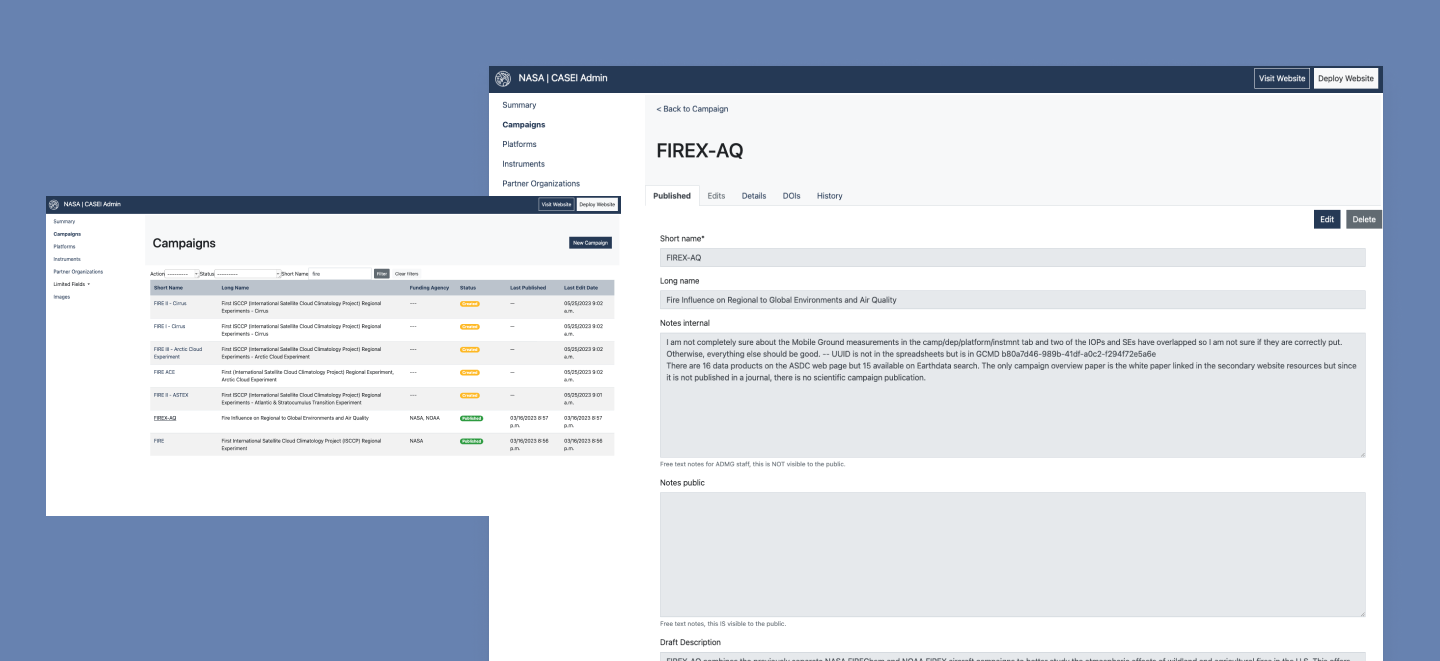
CASEI maintenance interface that allows data curators to add, review, and update metadata.
Reception
In July 2023, CASEI transitioned from beta to full release. Scientists and airborne/field data enthusiasts can now explore metadata and discover related observations for a majority of NASA’s known airborne and field campaigns by using the range of search/browse functionality built into CASEI and its API. ADMG won a NASA Silver Group Achievement Award for exceptional achievements exemplifying one or more of NASA’s Core Values — safety, excellence, teamwork, integrity, and inclusion.
The Way Forward.
CASEI's metadata inventory is constantly being updated. Additional campaigns, platforms, instruments, and data product associations are still being curated. The inventory will continue to grow and even change as ADMG learns more about the unique applications of the data. A well-organized, consistent, and conveniently accessible catalog illustrates NASA’s commitment to bridging the gap between satellite observations and suborbital data. CASEI will also continue to promote and enable the reuse of the data, which supports an ethos of Open Science and is a big part of the NASA Earth Science Data Systems (ESDS) Program’s mission for maximizing the return on the Agency’s investments in their collection and preservation.
Learn more about the Airborne Data Management Group and CASEI
- Airborne and Field Data Resource Center (https://www.earthdata.nasa.gov/centers/afdrc)
- NASA Earth Science Data Systems (ESDS) Program page (https://www.earthdata.nasa.gov/esds/impact/admg)
About NASA ODSI (formerly known as IMPACT)
NASA’s Marshall Space Flight Center Office of Data Science and Informatics (ODSI) is the agency’s premier center for data science innovation, driving groundbreaking scientific discoveries, and pioneering technological advancements and applications across all scientific fields. ODSI partners with Development Seed to advance NASA science through enhanced data science infrastructures and informatics, providing cutting-edge expertise, tools, and capacity building to support key programs and drive transformative scientific breakthroughs.
Related content
More for you
Have a challenging project that could use our help?
Let's connect
We'd love to hear from you.