
AI-Powered Climate Intelligence for African Climate Adaptation

Overview
The Adaptation Atlas Assistant is an LLM-powered application for querying and visualizing data from the CGIAR Africa Agriculture Adaptation Atlas. Developed in partnership with the CGIAR Climate Action program, the application enables users to explore climate hazards, agricultural exposure, and adaptive capacity data through an intuitive chat interface. Built with an extensible data backend and configurable model design, it uses Retrieval-Augmented Generation (RAG) to deliver accurate, data-driven insights on how climate change will affect agriculture across Africa.
Challenge
The Africa Agriculture Adaptation Atlas contains extensive tabular datasets on climate hazards, agricultural exposure, and adaptive capacity across the continent. However, navigating this wealth of information requires specialized knowledge of domain-specific terminology and dataset structures. Researchers, policymakers, and practitioners need accessible ways to query and visualize this data without deep technical expertise in data analysis or climate science.
Outcome
The Adaptation Atlas Assistant democratizes access to critical climate adaptation data. Through a conversational interface with a guided prompt builder, users can ask plain-language questions and receive responses with charts, maps, and contextual explanations. The open-source system, built with modern tooling, enables the Atlas team to continue iterative development and extend functionality as new datasets become available.
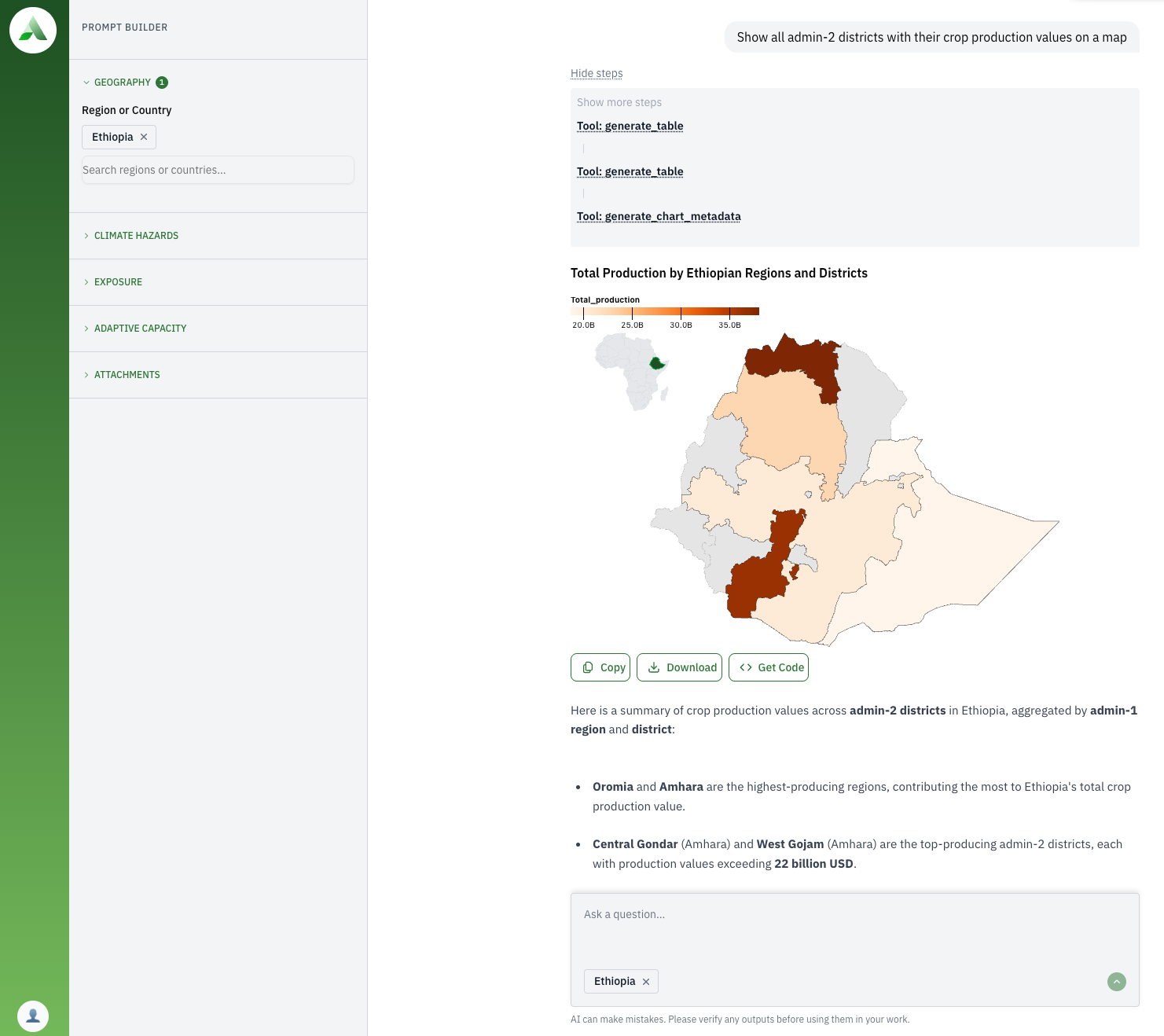
The Adaptation Atlas Assistant chat interface with prompt builder sidebar for exploring climate adaptation data.
Climate change poses an existential threat to African agriculture, affecting the livelihoods of millions. Understanding where hazards will strike, which crops and communities are most exposed, and what adaptive capacity exists requires synthesizing vast amounts of data. The Adaptation Atlas Assistant makes this intelligence accessible to everyone working on climate adaptation strategies.
The application was developed through an extensive discovery process with the CGIAR Africa Agriculture Adaptation Atlas team. Through user journey mapping and prioritization exercises, Development Seed refined the design to meet the expressed needs of researchers, policymakers, and practitioners who need to understand climate impacts on agriculture.
How it works
At the core of the Adaptation Atlas Assistant is a tool-calling LangChain agent equipped to discover, navigate, and describe Adaptation Atlas data. Users interact through a center chat interface that displays both queries and responses, including dynamically generated charts and visualizations.
A prompt builder sidebar guides users through domain-specific terminology and dataset-specific queries, helping them construct effective questions about:
- Geography: Specific regions, countries, or administrative areas across Africa
- Climate Hazards: Drought, flooding, heat stress, and other climate risks
- Exposure: Agricultural systems and populations at risk
- Adaptive Capacity: Resources and capabilities to respond to climate impacts
The platform's technical foundation includes:
- Data sourced from the Adaptation Atlas STAC Catalog using Retrieval-Augmented Generation (RAG)
- A lightweight embeddings database that enables precise data discovery
- Backend powered by LangChain with configurable model support
- Observable Plot for rendering interactive charts
- Frontend built with React and TypeScript, bundled with Vite
- Authentication handled through AWS Cognito
This architecture makes the Adaptation Atlas Assistant both powerful and extensible. New datasets can be added by updating the STAC Catalog and triggering a redeployment to regenerate the embeddings database.
Infrastructure
The application backend is served with FastAPI and deployed on AWS using Terraform-managed infrastructure. The system includes:
- An Elastic Container Service (ECS) cluster with automatic scaling
- Application Load Balancer distributing traffic across availability zones
- Cognito serving as an OIDC Identity Provider for secure access
- GitHub Actions handling continuous integration and deployment
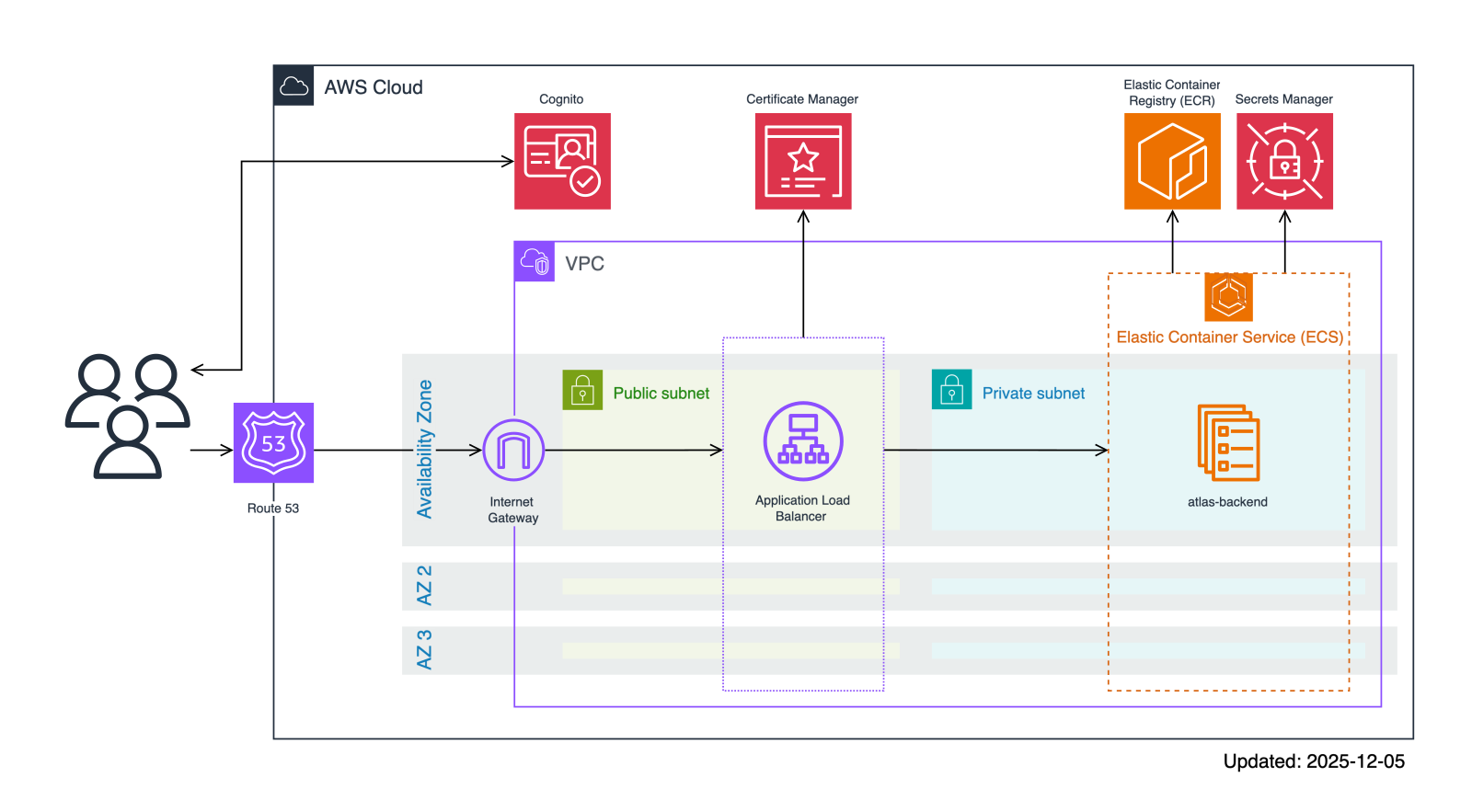
AWS infrastructure architecture for the Adaptation Atlas Assistant.
The infrastructure was designed for flexibility. While currently deployed on AWS, the containerized architecture allows migration to institutional or on-premises servers as needed.
Partnering for Impact
Development Seed partnered with the CGIAR Climate Action program to design, prototype, and launch the Adaptation Atlas Assistant. Our work encompassed the full product lifecycle, from discovery sessions and user journey mapping to design, development, and deployment.
We designed the conversational interface that makes complex climate data approachable for non-technical users. We architected the agent workflows connecting language models to deterministic data retrieval tools, ensuring results are grounded in validated datasets. We built the system's API and visualization stack to handle Africa-wide data efficiently while maintaining performance.
By building the application in the open with open-source tools, our goal has been to enable the Atlas team to take the application forward, extend it with new datasets and functionality, and continue serving the climate adaptation community.
Acknowledgments
This work was developed in partnership with the CGIAR Climate Action program and the Alliance of Bioversity International and CIAT, with support from the Bill & Melinda Gates Foundation.


Related content
More for you
Have a challenging project that could use our help?
Let's connect
We'd love to hear from you.