

A lack of diversity, burnout and lone-wolf development aren't new to open source, but AI is amplifying them. Paying down that social debt takes the same deliberate time and planning we give our code.

Following her closing keynote at FOSS4G North America, Brianna Pagán Corremonte, PhD reflects on a challenge facing open geospatial communities: the growing strain on the social infrastructure that makes open collaboration possible. As AI reshapes how we build and contribute to open source, she explores why sustaining our communities requires investing in people and relationships with the same intention we bring to maintaining our technology.
Last week I was set to give the closing FOSS4GNA plenary presenting findings from the Cloud-Native Geospatial Forum’s Beyond Open Data paper in a talk titled “Open Data Isn’t Open Source.” One of the paper’s conclusions was that “the power of open data comes from the ecosystem, not the license,” and that the path forward is to treat the ecosystem, not the dataset, as the thing worth maintaining. I was already hoping to lean into discussing the social infrastructure of our ecosystem, but I couldn’t have anticipated the recent public fallouts involving AI (i.e. contentions around using AI to port popular geospatial tools to Rust or an attempt to remove the zarr driver in GDAL due to AI contributions) hitting our niche corner of the internet, its impact on individuals and responses from organizations.
As someone who belongs more on the data side of geospatial communities than the open source software side, it felt uncomfortable and maybe not my place to bring this up. At the same time, something in the airing of frustrations resonated. After reflecting, I realized that AI is accelerating our social debt in these open communities, but it’s a debt we’ve been accumulating for decades before AI. As a BIPOC woman in these spaces, I’ve felt it directly time and time again.
Social debt is the human side of technical debt
Social debt is defined as the “cumulative and increasing cost... connected to invisible and negative effects within a development community.” Unpaid technical debt shows up as slower development, more bugs and outages, and higher maintenance costs. Unpaid social debt shows up as burnout, a lack of diversity and governance crises. Unlike technical debt, social debt can’t easily be measured in dollars, and it’s hard to name. But it doesn’t stay social. It bleeds into technical outcomes and appears as misaligned goals, lower product quality, abandoned projects and high turnover.
Who pays the interest on this debt is not evenly distributed. Women, BIPOC and LGBTQ+ contributors are most impacted. A study from the Society of Women Engineers surveying over 3,000 engineers found women and people of color were more likely than white men to do “office housework” like finding a time everyone can meet and taking notes. Another term I’ve learned for this is glue work, which also includes onboarding, documentation, making sure the right people are talking across teams, and building consensus. Glue work is often exactly the work that pays down our social debt, and we keep handing it to minority groups.
Clashing working styles also create psychologically unsafe conditions. We consistently reward the fastest, loudest and, in some cases, most combative voices, and we lose the people who work through relationships, consensus and care. I’ve experienced this firsthand. It has led me to rage quit more than one open source project, and, frustratingly, I’ve noticed myself picking up some of those bad habits.
Tech culture also idolizes the lone genius and the 10x engineer. Social debt research has a name for this: the lone wolf effect, one of several “community smells.” Its costs are information silos, which are bad for communities, and burnout, which is terrible for the individual.
“I have had to practice being willing to leave the space of my study to be in community, to work in community, and to be changed by community.” – bell hooks
AI as an accelerant
The already fragile social infrastructure of open source communities is now at real risk of breaking under AI. A few examples of how it’s adding to our social debt.
Newcomers are disappearing and AI is replacing the old process of asking in public and someone inviting a new person in. Previously, the way into an open source community was to get stuck and ask a question in the open, via GitHub issues, forum posts or in a slack channel. That first question makes a person visible and is the first step to someone from the inside inviting you in. These questions now go to a chatbot instead and causes a double blindness: the newcomer doesn’t know there is a community to join and the community never knows they were there. I would argue that underrepresented people especially rely on these invitations. At the same time, when you feel like a community isn’t meant for you, a chatbot feels safer, and that’s exactly how you stay invisible.
Maintainers are also being overwhelmed by AI-generated PRs, adding to more burnout. AI is making it cheap and fast to make a code contribution, but reviewing code still takes human time and judgement. Every pull request, even low-quality has to be read and while there are increasing suggestions of how to sort through AI slop versus a PR with real weight, that work is landing on the people who were already stretched thin and adds to the burnout that was already pushing maintainers out.
Lone wolf is becoming the default mode which will result in more silos, fragmentation and an excessive volume of new tools. When you can get an answer, generate code and ship a tool without ever talking to another person, working alone becomes the path of least resistance. AI is making that cycle faster. Instead of finding the existing library and contributing to it, it’s now easier to generate your own. The result is more one-off tools that nobody else knows about, and fewer shared projects with enough people around them to survive. The knowledge that used to get shared in public now lives in with one person and their chatbot.
As geoamish.org puts it:
“But new tools promise wonders. They promise to liberate us from a packaged concept of undesirable labor… No need for communities, a lonely stage for our egos. This is a deceitful allure.”
It's time to prioritize social debt
I don’t think anything I’ve written so far is groundbreaking. In most geospatial conferences I attend, there is always at least a nod to the importance of community, if not entire dedicated tracks. But what we need are more tangible ways to pay down our social debt, treated with the same urgency and planning we give technical debt. What if, for every technical backlog refinement meeting, we set aside the same time for reducing social debt? That could look like:
- Making invisible work visible
- Sharing glue work instead of defaulting it to the same people
- Deliberate invitations, so people feel seen and know they have a place
- Checking in on the psychological safety of colleagues
- Enforcing codes of conduct
I have seen some examples of what paying down social debt looks like in practice. One of the clearest examples is Openscapes, which “helps shift culture by mentoring researchers to move from lonely science as they skillbuild and navigate the open science landscape safely with their teams and communities.” I was part of the 2022 NASA Openscapes Cohort where I experienced firsthand their commitment to kinder science in practice. This included coworking sessions designed for people to find shared needs and each other as well as meetings that always open with check-ins to prioritize psychological safety. These small gestures build strong relationships, and I don’t think it’s a coincidence that so many people I’ve met through Openscapes have become longtime collaborators and friends.
Another example that has stuck with me was at a GeoJupyter hackathon, when the organizers put up a slide on team roles and addressed social debt head on. Every team had an observer whose job was to ask, “are we making space for everyone to speak?” Remote participants had a dedicated point of contact responsible for their inclusion. Teams were told to rotate who writes the code and encouraged people less comfortable with coding to ‘drive’ while others verbally guided (“please do not allow one person to do all the typing!”). My favorite: “Please do not assign a note-taker. Co-create your notes together!” In one slide, they shared the glue work, built in psychological safety, and made it nearly impossible to be a lone wolf.
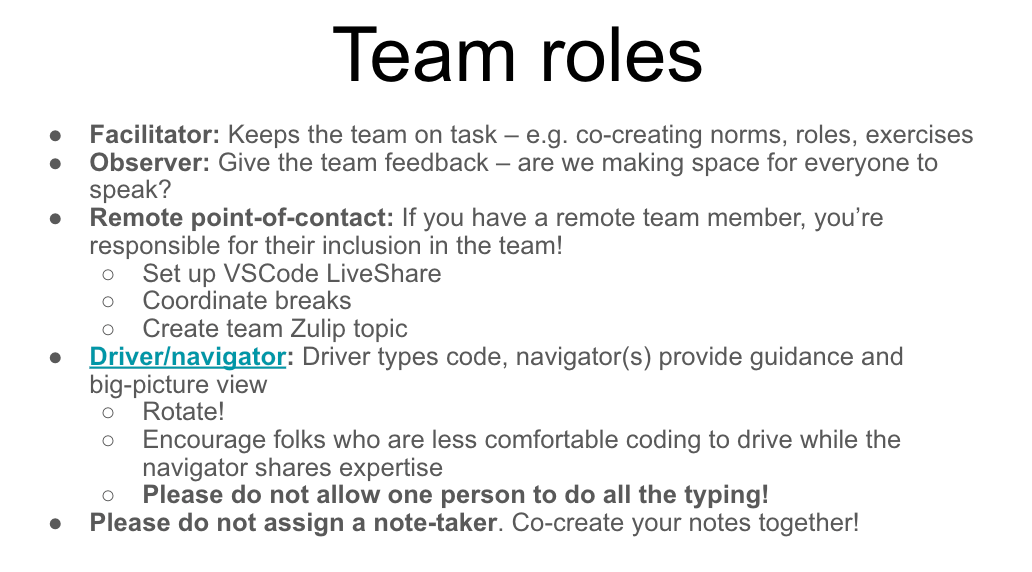
The team roles slide from a GeoJupyter hackathon, which shared out glue work and built in psychological safety.
The use of AI is only going to become a more divisive topic and it’s an existential time for most of us. My last ask, is that communities and conferences make dedicated spaces and time for discussing AI impacts. AI skepticism can make you feel like you’re falling behind. Understand that minority communities especially have a long history of reasons to mistrust new technologies (see Ruha Benjamins’s Race After Technology: Abolitionist Tools for the New Jim Code). At a time of ultra-fast speeds and the enshittification of, honestly, everything, let’s normalize slowing down and encourage the voices trying to do so.
AI didn’t create our social debt, but it’s making it impossible to ignore. Now more than ever the most valuable thing we can contribute might not be code but our time and support for each other.
What we're doing.
Latest