
Behind the Tech: Producing The Most Downloaded Earth Observation Dataset
- Estimated
- 4 min read

Cloud engineer Chris Holden knows what it's like to be on the other side of the data. Now he's helping researchers navigate a growing catalog of satellite observations and making it easier to put that data to work.

When Chris Holden joined Development Seed, he found a familiar email address in a database for one of the NASA programs he was helping support: his own.
Years earlier, Chris had been a remote sensing researcher using public and commercial satellite imagery for land cover analysis. Now, as a cloud engineer working on NASA's Harmonized Landsat Sentinel-2 (HLS) and Commercial Satellite Data Acquisition (CSDA) programs, he is helping build the infrastructure that researchers like him rely on.
"I've been on both sides," he says.
Chris started his career as a remote sensing scientist, earning a PhD while realizing that what he really enjoyed was building tools. He moved into software development in 2019, eventually working across machine learning, data pipelines, and cloud infrastructure. He was already familiar with Development Seed's work before joining the team a little over two years ago.
"I was a customer sort of before I became part of the team."
That perspective comes in handy when you're working on a dataset containing more than 30 million observations. One of Chris's accomplishments since joining Development Seed was fixing a bug in HLS that he'd encountered and worked around in his previous job.
NASA's Harmonized Landsat Sentinel-2 (HLS) program brings together observations from the NASA/USGS Landsat program and the European Space Agency's Sentinel-2 mission. It applies atmospheric corrections, masks observations affected by clouds and other conditions, and harmonizes the imagery so researchers can work with data from different sensors more consistently. Instead of preparing each source separately, researchers and operational users can access the processed data in a consistent format, saving significant time and effort.
His recent work has focused on incorporating algorithm updates and reducing processing costs and delays in the HLS product pipeline.
The HLS production team works closely with scientists developing the algorithms that preprocess and harmonize satellite imagery. As those algorithms improve, engineers need to make sure the code can reliably process millions of observations each year without unnecessary expense.
Chris draws on his scientific background to make the processing algorithms more efficient, while using his engineering expertise to improve the systems that run them. That means reducing both the computational cost of processing imagery and the delays and overhead involved in moving data through the pipeline.
Shortly after joining the HLS team, Chris eliminated unnecessary delays in acquiring Sentinel-2 imagery by moving to an event-driven approach that starts downloading data as soon as it's released. His ongoing work includes rearchitecting other parts of the pipeline to reduce costs, increase reliability, and remove unnecessary waits.
HLS sits between the original satellite observations from USGS and ESA and the people and systems that rely on them, including the disturbance and water extent datasets produced by the NASA OPERA team. Reducing the time between satellite acquisition and HLS availability could make a meaningful difference for users responding to disasters or monitoring rapidly changing conditions on the ground.
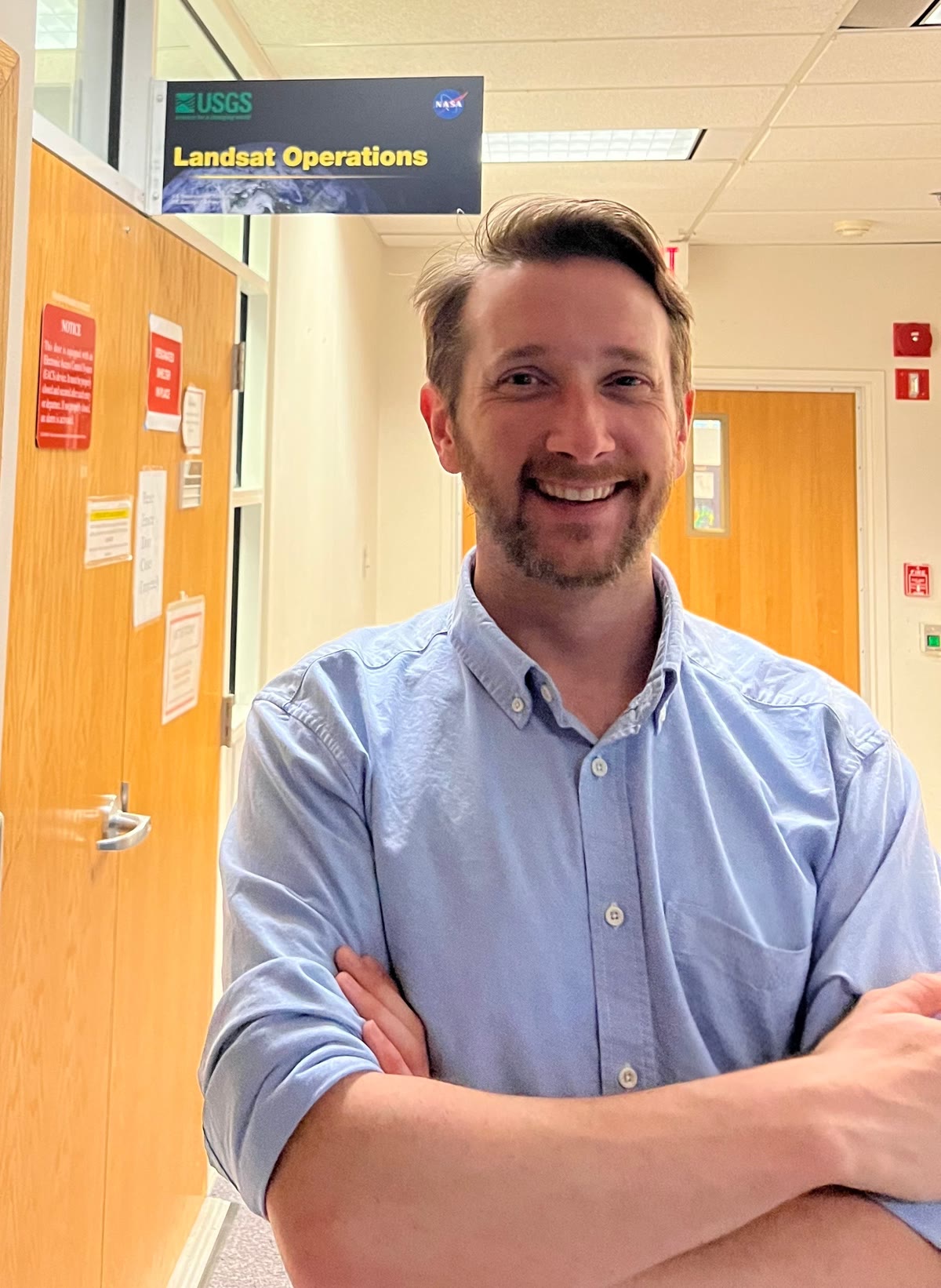
Chris at Landsat Operations, NASA Goddard Space Flight Center
Making data from different satellites work together introduces another set of tradeoffs. Each sensor has its own capabilities, and harmonizing their observations means deciding what to preserve, what to standardize, and where some detail may be lost. HLS makes Landsat and Sentinel-2 observations easier to compare, but that consistency comes at a cost: Sentinel-2's finer spatial resolution is reduced to match Landsat, and Landsat's thermal observations aren't included in the harmonized product.
It's a balancing act between standardization and flexibility, and one that Chris sees as part of a larger challenge across Earth observation.
We have an extraordinary amount of data available, but that doesn't necessarily mean we're making full use of it. Researchers still spend considerable time finding, accessing, and preparing observations from different sources before they can begin their analysis.
"If you have to get your pixels from a bunch of different places, that's just going to be a toil tax."
Chris imagines a future where those barriers are much lower. Better standards, interfaces, and tools could make it easier to combine observations from different sensors and put more of the available data to work in scientific models.
"If we get the interfaces and access patterns right," he says, "it becomes trivial to go to the supermarket of data and just pick it all off the shelf."
We have an extraordinary amount of data available, but that doesn't necessarily mean we're making full use of it.
For someone who clearly enjoys getting deep into the technical details, Chris is also surprisingly enthusiastic about what happens before the engineering begins.
Ask him about an underrated tool, and he'll make a case for diagrams, written documentation, and even ticketing. He's become increasingly convinced that understanding and organizing a problem is just as important as finding an elegant technical solution.
"If you don't know the contours of the problem you're trying to solve and you just go to the fun part, which is the solutioning, you might build something that isn't actually solving the real problem."
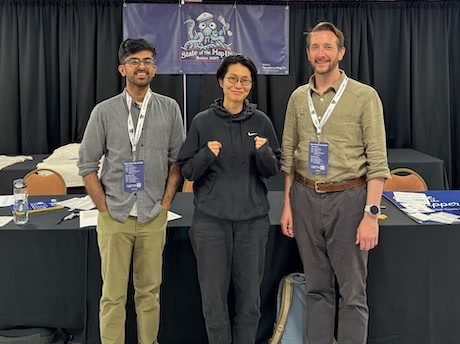
Indraneel, Hanbyul and Chris at State of the Map US 2025
It's an approach shaped by his experience on both sides of the data: knowing what researchers are trying to accomplish, understanding the systems standing between them and the observations they need, and doing the less visible engineering work that brings those two closer together.
Related content
More for you
What we're doing.
Latest