Zarr Structure
zarr-datafusion-search uses a set of 1D arrays to store metadata,
treating them as if they were columns in a columnar storage format like
Parquet.
Schema
The library requires a special group named meta. It discovers each array stored in the meta group and
maps its Zarr v3 dtype to an Arrow type to build an
Arrow schema. These are the
current supported type mappings.
Supported dtype mappings
| Zarr v3 dtype | Arrow type | Notes |
|---|---|---|
bool |
Boolean |
|
int8 |
Int8 |
|
int16 |
Int16 |
|
int32 |
Int32 |
|
int64 |
Int64 |
|
uint8 |
UInt8 |
|
uint16 |
UInt16 |
|
uint32 |
UInt32 |
|
uint64 |
UInt64 |
|
float16 |
Float16 |
|
float32 |
Float32 |
|
float64 |
Float64 |
|
VariableLengthBytes |
BinaryView |
When the field name is bbox, mapped to WKB with EPSG:4326 CRS via the GeoArrow extension type instead |
r<N> (raw bits) |
BinaryView |
|
VariableLengthUTF8 |
Utf8View |
|
numpy.datetime64[s] |
Timestamp(Second, None) |
|
numpy.datetime64[ms] |
Timestamp(Millisecond, None) |
|
numpy.datetime64[us] |
Timestamp(Microsecond, None) |
|
numpy.datetime64[ns] |
Timestamp(Nanosecond, None) |
|
complex64 |
— | Not supported |
complex128 |
— | Not supported |
Chunking
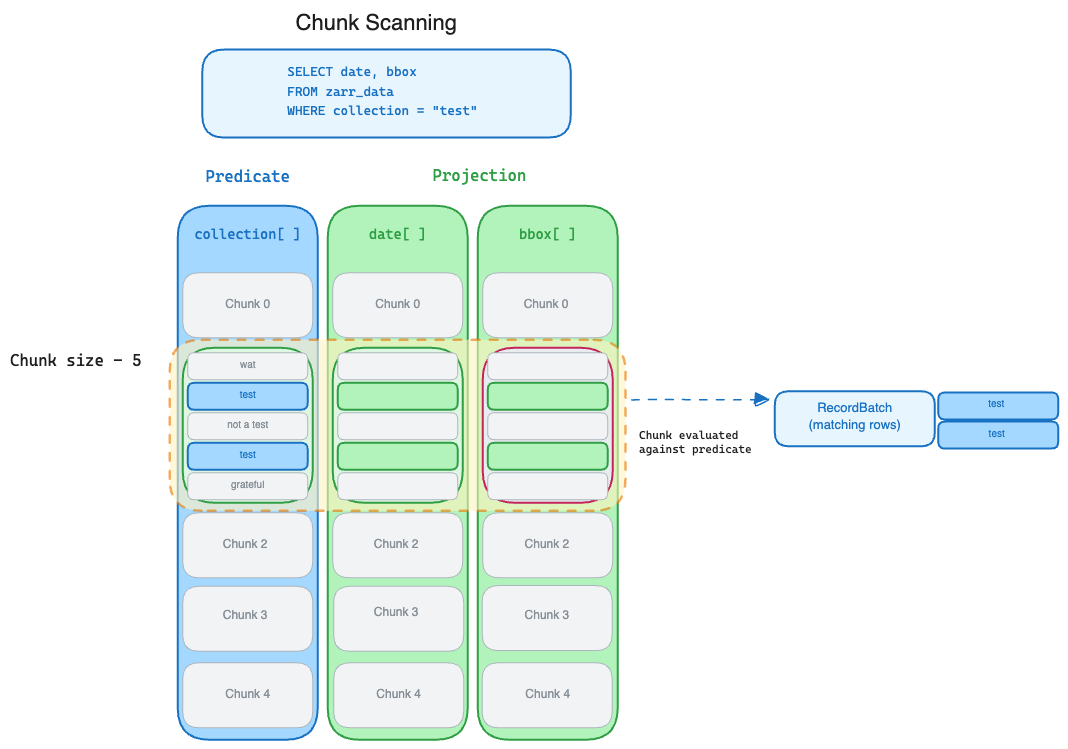
Because the meta arrays are combined by Datafusion into a single schema they
need to maintain chunk alignment. This means that during array creation time,
the chunk size must be the same for each array. And as data is appended, it needs to be appended to each array simultaneously.
Because the chunks are aligned across arrays, the library can treat the combined chunks similar to a Parquet row group.
This diagram demonstrates the chunk alignment
Indexes
zarr-datafusion-search supports the optional use of materialized indexes to improve
scanning performance. We use the following convention, if a meta
array is used in the filter predicate zarr-datafusion-search will look for a
group called indexes and search for an array of the same name as the
predicate array. Currently the only index type supported are R-tree indexes
generated by the geo-index
library but we will continue to expand index support.
Decoding performance
Whenever possible it is worthwhile to avoid including VariableLengthBytes fields in your query's projection. Variable length decoding incurs a significantly higher cost than decoding fixed width types and can drastically affect query performance. This is especially evident when an index is present and the actual chunks don't need to be materialized for filter operations. See the results of
as an example.