Merge Pipeline
lazymerge uses Cubed to lazily merge
geospatial Zarr arrays. The merge is expressed as a cubed.map_blocks
operation, meaning that each output chunk is computed independently and only
the source data needed for that chunk is read.
Overview
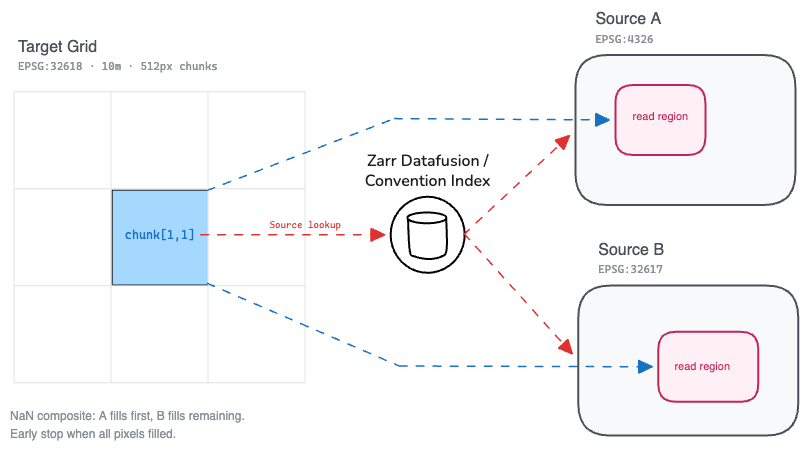
The pipeline has three phases:
- Target grid construction -- define the output array shape, CRS, resolution, and chunk layout.
- Per-chunk source discovery -- for each output chunk, find which source arrays intersect its spatial extent.
- Per-chunk warp and composite -- read the intersecting source regions, reproject them to the target grid, and composite them into the output chunk.
Target grid
merge() creates a target grid from the user-provided CRS, bounding box,
and resolution. This produces a SpatialAttrs (affine transform, shape,
bbox) and a ProjAttrs (CRS code). A lazy Cubed array filled with NaN is
allocated at the target shape and chunk size.
When temporal grouping or multi-band output is requested, extra dimensions
are prepended to the target array: (time, band, y, x), (time, y, x),
or (band, y, x).
Source discovery
For each output chunk, the pipeline computes the chunk's bounding box in the target CRS and finds intersecting sources using one of two strategies:
ScanIndex -- a pre-built in-memory index created by scan_store(). Each
source entry stores its spatial extent and CRS, and bounding box intersection
is checked after reprojecting to the target CRS.
DataFusion -- a SQL query against the /meta group in the Zarr store
(via zarr-datafusion-search). The chunk bbox is reprojected to EPSG:4326
and used in a ST_Intersects spatial filter. This path supports
sortby (controlling composite priority) and sql_filter (arbitrary
attribute predicates).
When temporal grouping is active, an additional SQL filter restricts sources to the time window for the current time step.
Overview selection
When a source has a multiscale pyramid (indicated by a multiscales
attribute on its Zarr group), the pipeline selects the coarsest overview
level whose pixel size does not exceed the target resolution. This avoids
reading full-resolution data when the output is at a coarser scale.
The target resolution is converted to the source CRS before comparison, handling cases where the target and source use different CRS with different units.
Lazy virtualization
When a virtualize callback is provided, each source is virtualized into the
store before its pixel data is read. This allows COGs (or other non-Zarr
formats) to be converted to virtual Zarr references on demand, rather than
requiring an upfront bulk virtualization step.
The built-in default_virtualizer factory creates a callback that:
- Converts HTTPS S3 URLs to
s3://protocol equivalents. - Uses VirtualiZarr + VirtualTIFF to write virtual chunk references for each band and overview level into the Icechunk store.
- Writes Zarr conventions (spatial, proj, multiscales) so that subsequent reads can discover and navigate the virtualized arrays.
Virtualization is coordinated with a per-source futures mechanism: a
ThreadPoolExecutor runs callbacks, and a lock-protected dictionary ensures
each source is virtualized exactly once. If multiple chunks reference the
same source concurrently, only the first triggers the callback -- the rest
block until it completes.
Warp and composite
For each source intersecting a chunk:
-
Pixel mapping -- an affine + CRS transform maps every target pixel center to fractional source pixel coordinates. For cross-CRS merges,
pyproj.Transformerhandles the reprojection. -
Region read -- the bounding pixel range in the source is computed from the mapped coordinates. Only this subregion is read from the Zarr array.
-
Resampling -- source pixels are sampled at the mapped coordinates using nearest-neighbor interpolation.
-
NaN compositing -- the warped source data fills NaN pixels in the output. Sources are processed in order (scan index order, or
sortbyorder for DataFusion), and once all pixels in a chunk are filled, remaining sources are skipped (early stop optimization).
Execution model
Because the merge is a cubed.map_blocks call, Cubed controls scheduling.
Each chunk is an independent task that can be executed in parallel. The
library reads source data via zarr-python, which supports local
filesystems, cloud object stores, and Icechunk repositories.