Data structures
This page defines the data-representation concepts the rest of the guide leans on. Two orthogonal axes — gridded vs. ungridded and structured vs. unstructured — set up the vocabulary, regridding is the operation that moves data between them, and a datacube is the analysis-ready destination.
Reference material on satellite product taxonomy (swath geometry, analysis-ready data specifications, agency processing-level schemes) is out of scope here — see the glossary's Satellite data products section, whose entries link to canonical external references.
Two spaces
Most of what follows describes the relationship between two distinct spaces:
- Index space — the integer-indexed structure of the array itself. A value
is addressed by its position
(i, j[, k]). Has no inherent units. - World space (also "physical space" or, in geospatial work, "geographic space") — where each value actually sits in a CRS. Has units (meters, degrees, kelvin-along-a-vertical-axis, …) defined by the CRS.
Gridded data is data that has both spaces, plus a mapping between them (the "grid geometry"). Ungridded data lives only in world space, with no index space at all — each record carries its own world-space coordinates.
Gridded vs. ungridded
The first question to ask of any dataset: is it on a grid at all?
-
Gridded data lives in both index space and world space, with the mapping between them — the "grid geometry" — stored separately from the values. The mapping can one of three common forms:
- an affine transform plus a CRS — the GeoTIFF / COG convention.
(x, y) = affine @ (i, j); no per-cell coordinate arrays stored. - 1-D coordinate arrays per axis for a regular grid (
x[nx],y[ny]) — the CF / NetCDF / Zarr convention. - 2-D coordinate arrays per cell for a curvilinear grid
(
x[i, j],y[i, j]).
Examples: a satellite Level-3 product on a regular lat/lon grid, a climate-model output, a reanalysis dataset, a COG.
- an affine transform plus a CRS — the GeoTIFF / COG convention.
-
Ungridded data lives only in world space — no index space, no array structure. Each value carries its own coordinates
(x[k], y[k])in whatever CRS the producer chose (geographic or projected). There's no rowiand columnj, only individual observations. Examples: weather stations, ocean buoys, GNSS receivers, lidar/GPS point clouds, in-situ vertical profiles, aircraft tracks.
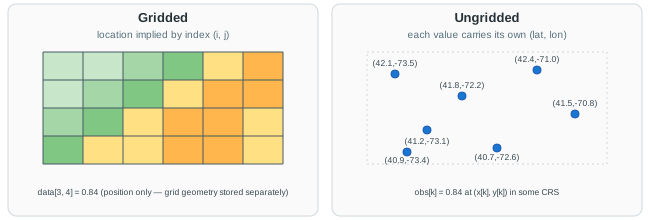
The same physical quantity (say, surface temperature) can be represented either way. Ungridded observations are often the input to a regridding step that produces a gridded product (see Regridding below).
Structured vs. unstructured
A second, orthogonal axis applies to gridded data: how is cell connectivity defined? This axis says nothing about ungridded data — ungridded data has no grid topology at all.
- Structured grid: cells form a regular logical array addressable by integer
indices
(i, j[, k]); connectivity is implicit (neighbors of(i, j)are(i±1, j)and(i, j±1)). Includes regular (rectilinear) grids and curvilinear grids — logically rectangular but physically warped, common in ocean models. - Unstructured grid (mesh): cells (triangles, polygons, sometimes mixed) are joined by an explicit connectivity list; nodes have variable numbers of neighbors. Examples: ICON, MPAS, FVCOM, finite-element meshes. Storage and access patterns are fundamentally different from structured grids.
- Discrete Global Grid Systems (DGGS): a third option that doesn't fit
neatly into structured-vs-unstructured. A DGGS tiles the whole sphere with
a single (often equal-area) cell family and a hierarchical refinement scheme;
cells are addressed by a specialized cell ID, with connectivity and
refinement encoded in the ID's arithmetic — no
(i, j)array shape, and no explicit connectivity list. Examples: HEALPix (equal-area quadrilateral cells with ring/nested indexing), H3 (hexagonal cells with a hierarchical hex ID), S2 (quadrilateral cells on a cubed sphere), rHEALPix, cubed-sphere. Standardized by the OGC DGGS abstract specification.
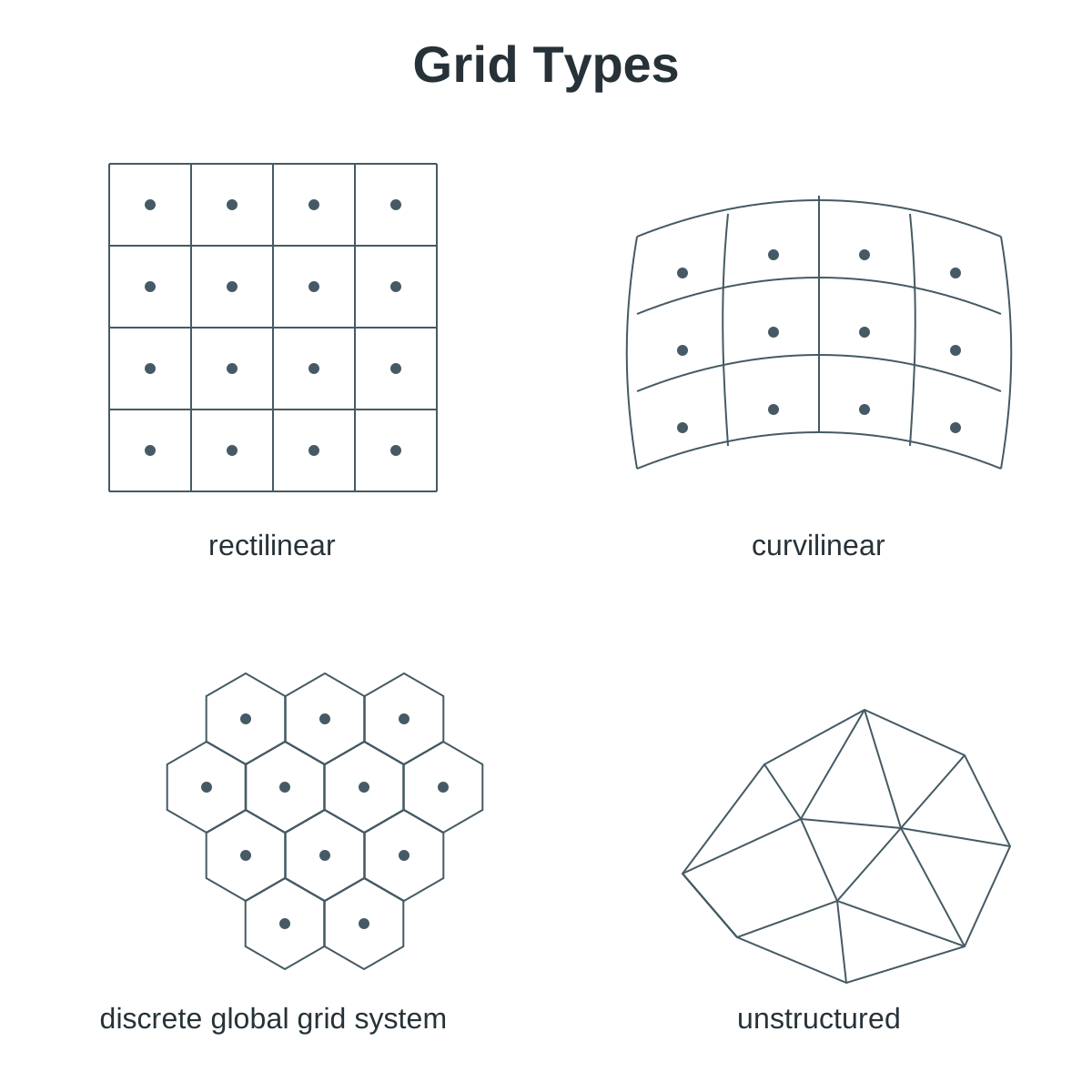
The two axes combine: a dataset can be gridded + structured (most satellite Level-3 products), gridded + unstructured (an ocean-model output on a triangular mesh), gridded + DGGS (a HEALPix cosmology map; an H3 hex map), or ungridded (irrelevant to this axis — there's no grid).
Regridding / resampling
Regridding (or resampling) is the operation that moves data from one spatial sampling to another — from ungridded or unstructured input onto a regular grid, or between two grids. It is the verb connecting the preceding nouns to the datacube that follows. The previous section's diagram, read right-to-left, illustrates the simplest case: scattered ungridded points resampled onto a regular grid.
The choice of interpolation method matters more than people expect:
| Method | Behavior | Use for |
|---|---|---|
| Nearest | Picks the closest source value; preserves values exactly; blocky. | Categorical / class data (land cover, flags). |
| Bilinear (linear) | Weighted average of the four surrounding cells; smooth; blurs sharp edges. | Smooth continuous fields (temperature, reflectance). |
| Conservative | Area-weighted; preserves area-integrated totals across cells. | Extensive quantities — fluxes, precipitation, mass. |
A useful rule of thumb: match the method to the quantity. The wrong choice silently corrupts downstream analysis — bilinear on precipitation does not conserve total water; nearest on a categorical mask preserves classes but bilinear on the same mask produces nonsense fractional categories.
Common Python tooling: xESMF (xarray-friendly, supports conservative
regridding via ESMF), pyresample (especially for swath → grid),
rasterio.warp.reproject (GDAL-backed, the GeoTIFF/COG path),
scipy.interpolate for one-off cases.
For empirical performance trade-offs across these tools, see Development Seed's warp/resample profiling benchmark, which measures memory and time across local vs. S3 storage and NetCDF, Zarr, and GeoTIFF sources.
Datacube
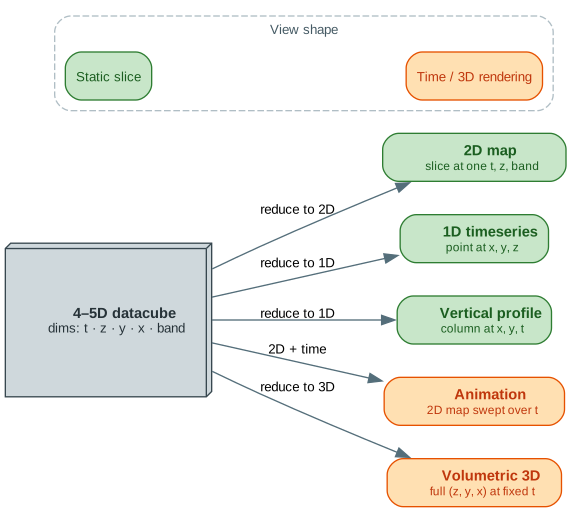
A datacube is a labeled, regularly-gridded N-dimensional array — dimensions
carry coordinates (e.g. time, level, lat, lon, band), and the data is
addressable by those coordinates rather than only by integer index. Typical
sizes span 3–5 dimensions.
A datacube is inherently a structured, gridded representation. It is most
often the product of gridding either ungridded or unstructured-mesh data onto
regular grids — i.e. the destination of the previous section's operation.
Common containers include Zarr (cloud-optimized), NetCDF, and HDF5; the
in-memory representation is typically an Xarray Dataset when using Python.
For a deeper look at how a datacube's dimensions reduce to common viewing shapes (maps, time series, profiles, animations), see the visualization overview.
External references
- UGRID conventions (unstructured-mesh in NetCDF): ugrid-conventions.github.io/ugrid-conventions/
- CF conventions: cfconventions.org/
- xESMF (regridding for xarray): xesmf.readthedocs.io/
- pyresample (geospatial resampling): pyresample.readthedocs.io/
- Open Data Cube: www.opendatacube.org/